Monday, March 3, 2008

CISTUS CRETICUS SPP. CRETICUS

The plant Cistus Creticus spp. Creticus belongs in the family Cistaceae and is synonym:
1. Cistus Incanus.
2. Cistus Villosus.
3. Cistus Polymorphus.

Labdanum from cistus creticus is the myrrh Old Testament.


"The Adoration of the Magi" El Creco Dominikos Theotokopulos(He comes from area of labdanum).


Myrrh is mentioned in the Bible (Psalm 45:8; Song of Solomon 4:14) and is believed to have been a mixture of myrrh and the oleoresin labdanum. One of the three gifts the Magi brought to Jesus Christ (Matthew 2:11) was myrrh. Myrrh gum resin was also used as a stimulant tonic and is even used today as an antiseptic in mouthwashes as well as to treat sore gums and teeth.


Tuesday, February 19, 2008

Labdanum From Wikipedia, the free encyclopedia

Labdanum is a sticky brown resin obtained from the shrubs Cistus ladanifer (western Mediterranean) and Cistus creticus (eastern Mediterranean), species of rockrose. It has a long history of use in herbal medicine and as a perfume ingredient.

History

I
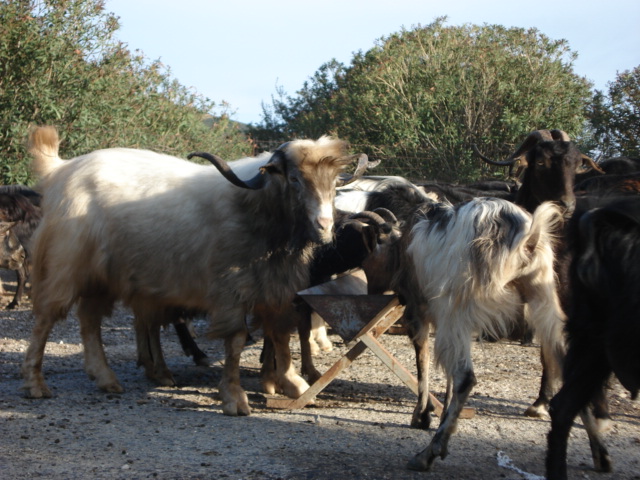
n ancient times, the resin was scraped from the fur of goats and sheep that had grazed on the cistus shrubs. It was collected by the shepherds and sold to coastal traders. The false beards worn by the pharaohs of ancient Egypt were actually the labdanum soaked hair of these goats. Later long poles with leather or cloth strips were used to sweep the shrubs and collect the resin which was later extracted. It was used to treat colds, coughs, menstrual problems and rheumatism.

Modern uses
Labdanum is produced today mainly for the perfume industry. The raw resin is usually extracted by boiling the leaves and twigs. An absolute is also obtained by solvent extraction. An essential oil is produced by steam distillation. The raw gum is a dark brown, fragrant mass containing up to 20% or more of water. It is plastic but not pourable, and becomes brittle with age. The absolute is dark amber-green and very thick at room temperature. The fragrance more refined than the raw resin. The odour is very rich, complex and tenacious. Labdanum is much valued in perfumery because of its resemblance to ambergris, which has been banned from use in many countries because its precursor originates from the sperm whale, which is an endangered species. The odour is variously described as sweet, woody, ambergris, dry musk, or like that of leathe.

http://en.wikipedia.org/wiki/Labdanum


Labdanumaus Wikipedia, der freien EnzyklopädieWechseln zu: Navigation
Ladanum oder Laudanum ist ein Harz, das im Mittelmeergebiet aus verschiedenen Arten von Zistrosen gewonnen wird. Im Sommer tritt unter Sonneneinwirkung das ölige Harz aus den Blättern und Zweigen, als würde die Pflanze schwitzen.

Schon im Alten Ägypten war Labdanum sehr beliebt. Das Harz wurde unter anderem auch als Räucherwerk verwendet. Wegen seines ambra-artigen, balsamischen, trocken-holzigen Duftes wird es heute auch als Rohstoff für die Parfumindustrie verwendet.

Die Bezeichnung Labdanum hat ihren Ursprung im syrisch-phönizischen Sprachraum. Dort wurde die Pflanze als "Ladan" (klebriges Kraut) bezeichnet. Es wurde zur Schönheitspflege sowie als Heilmittel benutzt.

In der Antike wurde vor allem das Harz der Kretischen Zistrose (Cistus creticus) verwendet. Zu dieser Zeit wurden zur Gewinnung des Harzes Ziegen durch die Sträucher getrieben. Anschließend wurde das an den Haaren klebengebliebene Harz herausgekämmt und zu Klumpen gepresst.

Heute wird es meist aus der Lack-Zistrose (Cistus ladanifer) gewonnen. Diese produziert bedeutend mehr Harz und kommt nur im westlichen Mittelmeergebiet (Südfrankreich, Spanien, Portugal, Marokko) vor.

Auch in der Bibel wird es erwähnt (Gen 37,25 EU, Gen 43,11 EU)
http://de.wikipedia.org/wiki/Labdanum

LADANUM

Gomme résine aromatique fournie par quelques plantes et principalement par le ciste de Crète. Les Égyptiens récoltent le ladanum en frappant l’arbrisseau avec des lanières de cuir. La masse noire et visqueuse ainsi recueillie est employée en médecine comme stimulant ainsi qu’en parfumerie.

Sunday, November 11, 2007

LADANUN OR LABDANUM FROM CISTUS CRETICUS SPP. CRETICUS

"In ancient times the valuable aromatic gum ladanum was gathered manually from Cistus creticus subsp. creticus, especially in Crete and Cyprus. The gum is exuded from glandular hairs on the leaves and young stems, especially under hot sunshine. It was gathered by allowing goats to graze on and among the plants; the ladanum adhered to their beards, which were then cut off. Alternatively a device called a ladanisterion or ergastiri, with long thongs of leather, was drawn over the plants by hand during the hottest part of the day, when the ladanum was at its runniest and stickiest.. The leather thongs became caked with ladanum, which was then scraped off and formed into lumps of various shapes. A very small amount of ladanum is still gathered in this traditional way in a small area surrounding a village in northern Crete."

http://www.cistuspage.org.uk/perfumery.htm

Friday, November 9, 2007

AREA OF LADANUM

http://www.labdanum.gr labdanum from Cistus Creticus – Sises Rethimno Crete

My name is Niktaris Dimitris.
I'm from Sises Rethimno of Crete GREECE.Sises is a village in northern Crete where there is produces ladanum only of all the world with the following characteristics:

1. Labdanum or ladanum produces from the plan Cistus Creticus.
2. Also It produces with an ancient and traditional way.

Labdanum or ladanum from this plan (Cistus Creticus) and with the impressing traditional method of produce has THE BEST quality.

I have made this site : http://www.labdanum.gr/ in English language

http://www.ladanum.gr/ in Greek language.
I have collected information for labdanum or ladanum (Cistus Creticus).

I will be pleasant if we have a contact.
My e-mail : ladanum@gmail.com

Niktaris Dimitris.
Sises Rethimno of Crete.
GREECE.
74057.
e-mail:
ladanum@gmail.com

Thank you.

Thursday, November 8, 2007

The collection labdnum is really difficult work.


The collection labdnum, with the old ancient way, is really difficult work. It becomes under boiling hot helium of summertime.


Nevertheless many times over participate also women.


SEASON - CONDITIONS


Period of collection: MAY - AUGUST


Conditions of collection: sunlight with temperature above 30 C and it prevails stillness.


The microclimate of region of village Sises Rethimno is the mainer reason that prevails still this way in this point from the all world.

Monday, September 3, 2007

Tool of the ladanum or labdanum (ladanesterion).


1.Tool 1700 just as Joseph Pitton de Tournefort
The tool was constituted by leather leads by the season of Pedanios Dioskurides 1 century AC. and in order that describes the French botanist in his travel in Crete in 1700.

2.Tool today .
Today they have been replaced with plastic.

Weight : 2-4 Kgr.

Saturday, June 9, 2007

GATHERING IN VIDEO


Friday, June 8, 2007

GATHERING IN FOTO

In Sises exist big regions, where they flourish exclusively Cistus Creticus. ONLY THOSE THAT HAVE MAUVE flowers, produce labdanum. This regions are named labdanum place.


In the dues of roughly May each year, as soon as it begins that is to say the heat of summertime, Cistus Creticus are ready in order to begins the meditation labdanum. In order to we collect the labdanum from plant, we use a ladanesterio, a manufacture by timber that above we have tied up her plastic leads. Striking these leads on t o plant, plastic gathers the “sweat of” seces. This sweat when congeal and it becomes black.


In order to it is gathered labdanum it should it makes heat and it has sunlight. When it is gathered labdanum by a plant, is needed one-one-two days in order to introduce the characteristic sweat, that is to say the liquid of Cistus Creticus that is become labdanum. The work of meditation labdanum is very tedious and laborious, because labdanum men it should it goes up and down in the mountains in the heat and in very big temperature.


After finish the meditation labdanum and the light blue leads of a ladanesterio, they have blackened, that is to say the sweat of Cistus Creticus it has congeal then it should we take from the leads labdanum. Consequently we leave ladanesterio, enough hour under the sun in order to become soft the black pastry that is found on the leads


The last stage of meditation labdanum is we take him above the ladanesterio. With the labdanum men we tighten lead and pulling, we gather labdanum. When it passes few hour the material that we gather, it becomes In order to we clean strap of ladanesterio and we gather labdanum, we use labdanum men. Labdanum men usually is combination from two locks


Saturday, June 2, 2007

Products 1. Labdanum resin 2.The first time Labdanum concret - labdanum absolute and 3. Solutions (labdanum from Cistus Creticus)

A. Labdanum resin is a natural product


The First Time


B)Labdanum concrete – Labdanum absolute. Solvent extraction.

Labdanum from Cistus Creticus is resin.
Method working: Solvent extraction.
Method steps : two.
Product: Labdanum concrete – Labdanum absolute.


The first step:
Α solvent such as hexane or supercritical carbon dioxide is used to extract the oils. Extracts from hexane and other hydrophobic solvent are called concretes, which is a mixture of essential oil, waxes, resins, and other lipophilic (oil soluble) plant material.

The second step:
Prep for all highly fragrant, concretes contain large quantities of non-fragrant waxes and resins. As such another solvent, often ethyl alcohol, which only dissolves the fragrant low-molecular weight compounds, is used to extract the fragrant oil from the concrete. The alcohol is removed by a second distillation, leaving behind the absolute.


C) Solutions


1. With pure alcohol. 2.with olive oil.

Monday, May 14, 2007

Labdanum: an important material


by
http://www.perfumeshrine.com/

It is well known to our readers by now that chypre perfumes are dependent on a strict formula that juxtaposes bergamot and oakmoss, interlaying labdanum and other earthy elements such as vetiver or patchouli.
Perfume Shrine has already focused on oakmoss extensively (click for relevant article), so the other important material that needed tackling was labdanum. And so here we are today, trying to examine some of its facets.

First of all, what is it? It comes as a sticky dark brown resin exudate from two sources: from the shrubs Cistus ladaniferus (western Mediterranean) and Cistus creticus (eastern Mediterranean), both species of rockrose. Rockrose forms the Cistaceae (or rock-rose family), a rather small family of plants reknowned for their beautiful shrubs, covered by flowers at the time of blossom. It consists of about 170-200 species in eight genera and those are distributed primarily in the temperate areas of Europe and the Mediterranean basin, although they can be found in North and South America too in some instances. The flowers themselves have a faint odour and are not used in perfumery.

Labdanum is a natural oleoresin but it differs slightly from other oleoresins in that it contains more waxes and less volatile oil than most of the other natural oleoresins.

There is an ancient background to labdanum, as its etymology reveals: lôt in Hebrew (coming from a semetic root) which means resinous herb, ladunu in assyrian, lâdhan in Arabic, ledanon in Greek and ladanum/labdanum in Latin. Egyptians used it in their Kyphi mixtures whereas the Hebrews burned it in their temples as incense, so it had a ceremonial character.
It is even referenced in The Bible (as Balm of Gilead): The Ishmaelite caravan coming from Gilead to which Joseph was sold, was transporting labdanum (Genesis 37, 25). Subsequently, Jacob ordered his sons to offer labdanum, along with other local products, to their brother, now an Egyptian dignitary:

"And their father Israel said unto them, If it must be so now, do this; take of the best fruits in the land in your vessels, and carry down the man a present, a little balm, and a little honey, spices, and myrrh, nuts and almonds."
(Genesis 43, 11) {found through Bible fragrances}.

It is believed that the above refers to the resin from the Pink Rockrose as "myrrh", although the two are not interchangeable. Myrrh per se is mentioned in the Bible (Psalm 45:8; Song of Solomon 4:14) and is believed to have been a mixture of natural myrrh (extracted from a tree in Africa and Arabia, like franckincense used to be got as well) and the oleoresin labdanum.

The Japanese use labdanum today in their Neriko mixtures, used during tea ceremony. The tradition is alive!

The use of ladbanum in medicine is well documented. Its high content in polyphenols makes it an excellent food supplement protecting the immune system.
In ancient times it was used for its properties of protection against bacteria and fungi. It is suggested that the Pharaohs used fake beards made of goat hair (from animals that had grazed upon the resiny bushes) for that reason, but also to surround themselves with an aura of distinction.
Greek physician Hippocrates prescribed "myrrh" (the mixture of natural myrrh and labdanum, as above) for sores and the Romans used it to treat worm infestations, the common cold, coughs, and some infections. Up to 3000 tons of frankincense and myrrh were transported each year during the height of Nabataean trade!
According to Cocker, J. D.; Halsall, T. G.; Bowers, A. (1956). "The chemistry of gum labdanum. I. Some acidic constituents" (Journal of the Chemical Society: 4259-62) and II. The structure of labdanolic acid" (Journal of the Chemical Society: 4262-71):


Labdane is a natural bicyclic diterpene that forms the structural core for a wide variety of natural products collectively known as labdanes or labdane diterpenes. The labdanes were so named because the first members of the class were originally obtained from labdanum, a resin derived from rockrose plants."

while


A variety of biological activities have been determined for labdane diterpenes including antibacterial, antifungal, antiprotozoal, and anti-inflammatory activities.
(Studies in Natural Product Chemistry : Bioactive Natural Products, Part F, Atta-Ur-Rahman)

Theophrastus and Pliny mention labdanum as does Herodotus in his Historia, in the book "Thalia" (one of a total of 9,named after the Muses):
"Ledanum, which the Arabs* call ladanum, is procured in a yet stranger fashion. Found in a most inodorous place, it is the sweetest-scented of all substances. It is gathered from the beards of he-goats, where it is found sticking like gum, having come from the bushes on which they browse. It is used in many sorts of unguents, and is what the Arabs burn chiefly as incense.
Concerning the spices of Arabia let no more be said. The whole country is scented with them, and exhales an odour marvellously sweet."

{*please note that the Arabs referenced by Herodotus are ancient tribes inhabiting the region called Arabia and not today's islamic populace}.

But then why the confusion with opiates? The answer goes back to the Middle Ages and Paracelsus. A famous medical preparation of his own -which included gold, crushed pearls and other ingrendients (Opera, 1658, i. 492/2), but with opium as its chief component. Therefore the term is now used for the alcoholic tincture of opium (q.v.). The name was either invented by Paracelsus from Latin laudare (=to praise), or was a corrupted form of "ladanum" (from Persian ladan), a resinous juice or gum obtained from various kinds of the Cistus shrub, formerly used medicinally in external applications and as a stomach tonic." (Source 1911encyclopedia.org)


Labdanum's odour profile is highly complex. It is balsamlike, with woody, earthy, smoky, and even marshy undertones. Some even desrcibe it as ambergris-like, or leathery and honeylike with hints of plum or oakmoss after a rain. Usually it is referred to as ambery, but it is mostly used to render leather or ambergris notes, the latter especially after its ban on using the real animal-derived material, as there were concerns about the ethical production of it from sperm whales from which it originates (Ambergris is therefore very rare and costly if ethically harvested and is mostly synthesized in the lab. Please read this amber article for more info).

Its complexity is one of the reasons it has fascinated people since antiquity and it has been reported to affect the subconsious in profound ways. Its aromatheurapeutic value is that it is grounding, warming and sensual.

The method of extracting it is unusual and highly entertaing at that. Herodotus and Pliny report that labdanum was collected by combing the beards of goats, which were impregnated with the substance. The goats graze from the branches and the sticky resin gets stuck on their beards. Upon their return, their owners comb the resin our of their beards and extract the resin. Also a rakelike instrument with long strips of leather attached to it, which they drag across the bushes to collect the resin, is used, called ladanesterion.
To this day labdanum is still gathered in Crete by driving goats into the thick forests overgrown with labdanum bushes. It is difficult work as it is best done in hot weather, under bright sunlight in the summer months. Sises is a Cretan village near Rethymnon, where such work is done to this day (coincidentally also the area from which El Greco/Dominikos Theotokopoulos comes).
You can read amazing detail on this matter on this site by Dimitris Niktaris: Labdanum Gr.

Today modern production is mainly concetrated in Spain and is done through easier means. However there is something to be said about the small, manual labour of cretan production that is of top quality.
The modern method involves boiling the leaves and twigs of this plant in water and the gum being skimmed off the surface and mixed with other resinous matter, which sinks to the bottom of the boiling water, as the resinoid is unsoluble in water. The extraction of the crude or cleaned labdanum gets done with a hydrocarbon solvent, whereas petroleum ether is being used increasingly because it yields a light amber resinoid which contains the most wanted odour principles in high concentration: cinnamon base - (isoeugenol) and labdanum resinoid. An absolute is obtained by solvent extraction whereas an essential oil is produced by steam distillation.

In perfumery it is used in many alloys, chypres notwithstanding and mixes well with hundreds of ingredients, interestingly one of which is lavender, another mediterranean herb.
Labdanum gum may contain up to 20% water, but this should be squeezed off or cautiously dried off. When in its fresh state, it is plastic but not pourable. It hardens on ageing, even to the point of becoming brittle. However if it is so at room temperature, it should be rejected as a starting material for the processing of labdanum derivatives.
Its shelf life is about 36 months and can be used in 10.0000 % in the fragrance concentrate.

One of the fragrances that focus on labdanum is Le Labo's Labdanum 18. Tagged as an enigma, to be used by both sexes, it focuses on the mysterious ambience that labdanum creates, fusing animalic and warm notes that meld on the skin.
Other fragrances that are rich with the note (but no guarantees on it always being naturally derived) are:
Donna Karan Essence Collection Labdanum ,Monia di Orio Lux, Dia for men by Amouage, L'eau Trois by Diptyque, Rien by Etat Libre d'Orange, Andy Tauer L'air du desert marocain ~Click for review~ (and reportedly it will feature in his Incense Duo as well), Patou pour Homme, Tabac Sport by Mäurer & Wirtz, Boucheron Pour Homme, Capucci Pour Homme, ST Dypont Signature pour homme, Eau Sauvage Extrême by Christian Dior, Whole Notes a floriental from Canadian perfumer Lyn Ayre of Coeur d’Esprit Natural Perfume, Prada, Prada Tendre and Prada Amber pour Homme, Mathew Williamson Incense, Ho Hang by Balenciaga, Jacques Bogart One man show, Ayala Moriel natural perfumes Ayalitta, Autumn and Democracy and Anya's Garden natural perfume Pan ~click for review~ that features real billy goat hair tincture.

by
http://www.perfumeshrine.com/

Saturday, May 12, 2007

Labdanum has fascinated people for many centuries.

Labdanum has fascinated people for many centuries. It is said to reach deep into our subconscious and bring back memories, pictures, feelings and moods. Labdanum originates from the rockrose bush, which emits a resinous dark brown mass from its leaves and twigs. To this day it is still gathered by driving goats into the thick forests overgrown with labdanum bushes. The goats eat their fill from the branches and the sticky resin gets stuck on their beards. When they return, their owners carefully comb the resin our of their beards. Also used is a rakelike instrument with long strips of leather attached to it, which they drag across the bushes to collect the resin. Labdanum strengthens the body and provides warmth and sensuality. It is very grounding. The fragrance of Labdanum is very complex. This waxy resin produces a balsamlike, woody, earthy, marshy, smoky, ambergrislike, leathery, flowery, honeylike, mintlike fragrance with hints of plum or oakmoss after a rain. The Japanese use Labdanum in their Neriko mixtures, which are used during tea ceremony. Egyptians used it in their Kyphi mixtures and the Hebrews burned it in their temples. Today the perfume industry uses labdanum to add a note of moss and leather to its products. Labdanum is an excellent medium for making fragrant incense pellets.

http://www.lilitu.com.au/incense_r.htm

Thursday, June 22, 2006

The Crook and Flail in Ancient Egypt

Ambergris - Known today as the rockrose, a shrub which produces beautiful, five-petal flowers; this plant was very famous in ancient Egypt. The whole genus, Cistus, is highly resistant to heat and drought. They have come into the warmer landscape as a staple flowering shrub that grows where few other plants stand a chance. It is a native of the Mediterranean region. Plants contain aromatic oils in abundance. The scent of rock rose oil is very powerful and distinctive. This oil of rock rose has since antiquity been of great value. It is called ladanum, which is reflected in the name of the most oil rich species, Cistus. What made ladanum so coveted is that its properties and scent were similar to ambergris, a byproduct of sperm whales. Collecting ladanum from wild rockroses was done through two methods. First was a process by which special absorptive materials such as cloth or hair was brushed over the top of the plants so that the oil built up on the fibers. It was then heated to release the oils under a more controlled extraction process. It is believed that the flail seen in the hands of gods and pharaohs of ancient Egypt was actually a ladanisterion, or ladanum collecting device. The second method of harvest utilized the herds of goats that are so prevalent in this part of the world. As the goats browsed on rockroses, the oil accumulated in their beards. Each year the long beards of the goats were cut and the oil extracted. For the pharaohs, the false beards glued to the chin were in fact these ladanum-rich goat beards which would surround the man with the desired scent. This is origin of the name for such facial hair, the goatee.


Egypt Feature Story


The Crook and Flail in Ancient Egypt


by Jimmy Dunn


The crook (heka) and the flail or flabellum (nekhakha), are two of the most prominent items in the royal regalia of ancient Egypt. Actual, very fine examples of both survive from ancient Egypt, as do statues and various wall reliefs, paintings and papyrus with representations of these objects. The crook and flail, though different scepters, could every so often be depicted separately, though usually paired with some other type of scepter, but they were most commonly represented together, held across the chest of the kings, Osiris, or other gods identified with them. They were insignias of kingship, and while other deities could proffer them, they never Note the flail held by King Narmer on his famous Palette, a very early example, but also note the lack of a crook.kept them.


................................. However, some scholars prefer to regard it as a ladanisterion, a flail-like instrument used until the present day by shepherds in the Mediterranean region and


............................. http://www.touregypt.net/featurestories/crooksandflails.htm


Flail ( Flabellum ) Symbol of Guardianship.


The flail has long associations with the gods Osiris, Min, and several sacred animals. And like the crook (Sceptre), it was one of the important insignias of royalty. Some scholars believe it to be a whip, maybe derived from a fly whisk. Whilst others think it represents the ladanisterion, an instrument used by very early goatherders. As such, it would symbolise, past traditions and the shepherding aspects of Pharaoh's role as king. The ancient Egyptian name for a flail was nekhakha .


http://www.ancientnile.co.uk/symbols.php


Sunday, May 28, 2006

BALM

Probable identification:

ladanum, gum gathered from the rock rose.

Botanical name and images:

Cistus salviifolius Cistus salviifolius

Hebrew:

lot

Assyrian:

ladanu

Old Testament:

Genesis 37:25, "As they sat down to eat their meal, they looked up and saw a caravan of Ishmaelites coming from Gilead. Their camels were loaded with spices, balm, and myrrh, and they were on their way to take them down to Egypt" (NIV).

Genesis 43:11, Jeremiah 8:22, 46:11, 51:8.

Tree:

The rock rose is a thorny shrub up to 70 cm high with showy white to pinkish flowers that resemble wild roses. The leaves are quite different, being simple and elliptical rather than compound. The fruit is a capsule that splits into several segments containing minute seeds.

Use:

The rockrose is the source of ladanum, a brown aromatic gum used in medicines and perfumes. Ladanum is collected by boiling shoots or raking the leaves by raking with a tool which has leather thongs in the place of teeth. The leaves are used in herbal teas, and rock roses are cultivated for their flowers.

Scripturally, balms and other ointments are metaphors for the healing power of divine mercy and comfort.

Occurrence:

Rocky brush country of Gilead and elsewhere in the Mediterranean region.

http://www.the-compleat-joiner.com/chart.php

Sunday, May 21, 2006

Ambergris

Known today as the rockrose, a shrub which produces beautiful, five-petal flowers; this plant was very famous in ancient Egypt. The whole genus, Cistus, is highly resistant to heat and drought. They have come into the warmer landscape as a staple flowering shrub that grows where few other plants stand a chance. It is a native of the Mediterranean region. Plants contain aromatic oils in abundance. The scent of rock rose oil is very powerful and distinctive. This oil of rock rose has since antiquity been of great value. It is called ladanum, which is reflected in the name of the most oil rich species, Cistus. What made ladanum so coveted is that its properties and scent were similar to ambergris, a byproduct of sperm whales.

Collecting ladanum from wild rockroses was done through two methods.

First was a process by which special absorptive materials such as cloth or hair was brushed over the top of the plants so that the oil built up on the fibers. It was then heated to release the oils under a more controlled extraction process. It is believed that the flail seen in the hands of gods and pharaohs of ancient Egypt was actually a ladanisterion, or ladanum collecting device.

The second method of harvest utilized the herds of goats that are so prevalent in this part of the world. As the goats browsed on rockroses, the oil accumulated in their beards. Each year the long beards of the goats were cut and the oil extracted. For the pharaohs, the false beards glued to the chin were in fact these ladanum-rich goat beards which would surround the man with the desired scent. This is origin of the name for such facial hair, the goatee.

http://thormans.org/Genevah/Cheopia/Lore/Aroma.html


Thursday, May 18, 2006

GODS love fragrances."

GODS love fragrances." That was a common saying among ancient Egyptians. To them, the burning of incense was very much a part of their worship. In the belief that the gods were near, the Egyptians burned incense daily at their temples and household altars and even while engaging in business. Other nations had similar customs.

What is incense? The term can refer to the smoke or to the substance burned. It is made of aromatic resins and gums, such as frankincense and balsam. These are pounded into a powder and are often mixed with such substances as spices, tree bark, and flowers to create certain fragrances for specific applications.

Incense was such a desirable and thus valuable commodity in ancient times that its ingredients became important items of trade. Caravans following trade routes carried these from distant lands. You may recall that Jacob's young son Joseph was sold to Ishmaelite traders who were "coming from Gilead, and their camels were carrying labdanum and balsam and resinous bark, on their way to take it down to Egypt." (Genesis 37:25) The demand for incense became so great that the frankincense trade route, no doubt initiated by incense merchants, opened up travel between Asia and Europe.

Incense is still offered in the ceremonies and rituals of many religions today. Additionally, more and more people choose to burn incense in their homes simply to enjoy its pleasant aroma.

video

the real labdanum from cistus creticus as fragrances.


Wednesday, May 10, 2006

University of Chicago


Tutankhamun for the Twenty-first Century: Modern Misreadings of an Ancient Culture
Robert K. Ritner

The following text was delivered at the first inaugural celebration for incoming University of Chicago President Robert J. Zimmer, hosted by the Chicago Society at the Field Museum of Natural History, Thursday, October 26, at 7:30 PM.

........................................................
The so-called "flail" was no slave-master's whip, but most likely an agricultural instrument, used to harvest ladanum-resin as is still done by shepherds in Crete and Cyprus.14
..........................................................
http://oi.uchicago.edu/research/is/ritner2006.html


14. H. G. Fischer, "Geissel," in Lexikon der Ägyptologie, vol. II, Wiesbaden: Otto Harrassowitz, 1977, cols.

Lot


The origin of the name of Avraham's nephew, Lot לוט, is unclear. Sarna writes that the origin is unknown, presumably following Cassuto, who rejects a connection to the name Lotan in Bereshit 36:20 (which is the suggestion by Kil in Daat Mikra on Bereshit 11:27) or a connection to the old Egyptian name of the eastern portion of the Land of Israel - Ruten - as suggested by Paton in The Early History of Syria and Palestine.

However, Rabbi Eldad Zamir writes here that: Lot is portrayed in a variety of different ways in the Torah, Midrash, and commentators. While at times he is portrayed as a positive figure, at times he is portrayed as a negative figure as well. This ambivalence can even be seen in Lot's name. 'Lot' has two possible meanings: it either comes from the noun lot (laudanum, a fragrant plant extract; see Bereishit 37:25, 43:11) or from the Aramaic verb lut (to curse; see Targum Onkelos, 12:3, et al.). Lot is either fragrant or worthy of curse.

Klein says that the name laudanum may derive from lot:

Probably related to Akka. ladunu, Arab. ladan ( = ladanum). Persian ladan is an Arabic loan word. Greek ledon ( = rockrose), whence ladanon ( = labdanum) is a Semitic loan word.

He also writes that the word "lotus" derives from lot, as does the Online Etymology Dictionary (who might be relying on Klein):

from L. lotus, from Gk. lotos, name used for several plants before it came to mean Egyptian white lotus (a sense attested in Eng. from 1584); perhaps from a Sem. source (cf. Heb. lot "myrrh")

Rashi on 37:25 identifies lot with לוטס - lotes as mentioned in the Mishna - Sheviit 7:6. However, the Mishna actually uses the word לוטם - lotem. Similarly, Shadal says that Onkelos translates lot as לטוס - but the edition of Onkelos that I have has the version לטום

letom. This confusion could be related to a mix-up between the letters samech and mem-sofit, but there is also a plant called lotem - from which, according to Felix, the fragrance lot is made.

As to the Aramaic lut, Jastrow says it derives from the root לוט meaning "to cover", and the development to the meaning "curse" comes from a sense of "to talk secretly". The root לוט is used in the Hebrew phrase לוט בזה - lut b'zeh - meaning "hereby enclosed" (explained here).

http://www.balashon.com/2006_11_01_archive.html


Saturday, April 15, 2006

Plants of the Bible

(Illustrated Manners and Customs of the Bible)


U. Myrrh. The King James Version uses the word myrrh with reference to different plants. One of these was a small tree with bushy branches and three-sectioned leaves, bearing a plum-like fruit, and producing a fragrant gum that had many uses. The Hebrew word for this plant was mor. It was used in anointing oil (Exod. 30:23), in perfume (Psa. 45:8; Prov. 7:17; Song 3:6), and in ceremonial cleansing (Esther 2:12). The magi brought it to the baby Jesus (Matt. 2:11). It was offered to Jesus on the cross (Mark 15:23), and was used to prepare Jesus' body for burial (John 19:39).

The myrrh mentioned in Genesis 37:25 and 43:11 was probably the tree Cistus creticus. The Hebrew word for this plant is lot. This shrub produces pink flowers and is sometimes known as the "rock "rose." It is very fragrant and valued for its perfume.

The tree that produces the myrrh used in modern times is not of the same genus or species as the myrrh of Bible times.
http://www.angelfire.com/sc3/wedigmontana/Plantsp7.html

Ladanum (Heb. lot, translated "myrrh" in Gen. xxxvii. 25, xliii. i i), the resinous exudation of Cistus creticus, C. ladaniferus and other species of "rock rose" or "rose of Sharon";

http://www.1911encyclopedia.org/Incense

Monday, April 10, 2006

Myrrh in the Old Testament

Myrrh- O.T.
Hebrew: lot
Cistus creticus

One of the best known stories is the betrayal of Joseph by his brothers in the Old Testament. Later when they were in desperate need of food, they went to him at Pharaoh's Court. In humility they asked for help to give them food. In Palestine in early spring, there thrives amid sand and rocks a small shrub. It is about the size of a dwarf rhododendron. Growing everywhere, on plains, mountain sides and in rocky desert areas, throughout the summer its flowers are seen. The myrrh flowers are shaped like wild roses and are rich pink deepening to a crimson red. Centered within the five petals are vivid gold stamens and a single erect pistil. It is the "rock rose," also known as the "lot plant." It provides a sweet smelling gum from all its parts and peasants have gathered it for centuries. They use a small stick wound around with soft cloth, and on calmer days, they carefully wipe the sweet substance from the shrub and round it into balls. It is then pressed into cakes that are used for perfume. This is the "lot" which through a mistranslation has been rendered in parts of the Old Testament as "myrrh." The true myrrh came from the plant called "mor."

Sunday, March 26, 2006

king Solomon


[The scented myrrh] permeates the pages of Solomon's writings with more references than any other Bible author.

.............................................................................

Other plants have been translated as balm that are not species of Commiphora. A handbook for Bible translators equates balm with Balanites aegyptiaca (L.) Del. (Zygophyllaceae),52 perhaps because the oil from the seed was used in embalming in Egypt.53 However, the best candidate for balm of Gilead appears to be Cistus incanus L., including C. creticus and C. villosus, (Cistaceae). Cistus incanus is a common and widespread plant in the Mediterranean region.

The extract of C. incanus is ladanum, or labdanum. It was widely used in the Mediterranean for a variety of medicines. Recent research has documented the medical efficacy of some compounds in ladanum.54 There is also strong biblical evidence that balm of Gilead is C. incanus. The weeping prophet, Jeremiah, refers twice to the balm from Gilead (Jer. 8:22, 46:11). While this could be Commiphora that had been transported there, a more natural explanation is ladanum. Stronger evidence is found in Ezek. 27:17 regarding trade in balm between Israel and Minnith.

........................................................................

http://www.asa3.org/ASA/PSCF/1999/PSCF3-99Musselman.html#54

11. ROSE OF SHARON/CISTUS - Also called Rock Rose or labdanum. This is a fragrance of prophecy, visions and all quests for truth. Rose of Sharon cannot provide answers, nor can it speak, but it stimulates the eternal knowledge that is intrinsic to all human beings. Rose of Sharon brings awareness that the universal spirit can be glimpsed and absorbed into our very being, although the complete merging with God must remain just out of reach while we fulfill our role here on earth.Not a true rose (Rosa damascena) the beautiful blooms of this plant have a soft honey-like scent and are thought to be the flowers of a shrub that grows wild on the Plains of Sharon just west of Jerusalem. “I am the rose of Sharon, and the lily of the valley.” (Song of Solomon 2:1)

http://aromaclasses.wordpress.com/2007/12/19/spiritual-emotional-uses-of-twelve-oils-of-ancient-scripture-kit/

Friday, March 24, 2006

Bible


Myrrh
From ancient times, the aromatic gum resin, myrrh, was extracted from a tree in Africa and Arabia, much the same way that frankincense was extracted. Then a mixture of resin, gum, and the essential oil myrrhol, was mixed to produce what was commonly known as myrrh. It had a bitter, pungent taste, and ranged in color from yellowish brown to reddish brown. It was highly valued in ancient times as an ingredient of perfume and incense, and was also used as an ointment. A similar product, known as Balm of Gilead or Mecca Myrrh, was obtained from a specific type of myrrh tree.

Myrrh is mentioned in the Bible (Psalm 45:8; Song of Solomon 4:14) and is believed to have been a mixture of myrrh and the oleoresin labdanum. One of the three gifts the Magi brought to Jesus Christ (Matthew 2:11) was myrrh. Myrrh gum resin was also used as a stimulant tonic and is even used today as an antiseptic in mouthwashes as well as to treat sore gums and teeth.
The Greek physician Hippocrates prescribed myrrh for sores and the Romans used it to treat worm infestation, coughs, and certain infections. Up to 3000 tons of frankincense and myrrh were transported each year during the height of Nabataean trade.

more
http://nabataea.net/items.html

Monday, March 20, 2006

Cistus creticus. Balm of Gilead. Dibbeen, Jordan. Cistaceae Why There May Be No Balm in Gilead

Balm of Gilead is an image familiar to Bible students even though it is mentioned in only two verses. The weeping prophet, as Jeremiah is known, writes in Jeremiah 8:22, "Is there no balm in Gilead? Is there no physician there? Why then is there no healing for the wound of my people?" What is this product of Gilead?First, what is Gilead? According to the biblical account in the book of Joshua(2), Gilead is apparently the region from the middle of the Arnon Gorge (Wadi Mujib) to Mount Hermon (Jebel Al Sheik) with the Jabbok River (Zarqa River) being the middle of the territory. This included the domain of the Ammonites and the Amorites as well as the region known as Bashan. In division of territory to the patriarchs, Gilead was apportioned to the half tribe of Manasseh (the other half remained west of the Jordan River), Reuben, and Gad.

Although a small area in terms of square kilometers, Gilead is diverse stretching from the margins of the Jordan valley and the peaks along the Rift Valley to the edge of the Badia (steppe).
In ancient times parts of Gilead were covered with forests. These forests were the southernmost extension of their kind, and the southern extreme of the range of the Aleppo pine. Today, only vestiges of these forests remain. A prime example is Dibbeen National Park.
......................................................................................................................................
Cistus' resin is fragrant, as noted, and has been used for millennia to produce an incense. Even today, the resin is collected in parts of Greece. It can be harvested in a variety of ways. One ancient method is to comb the hair of goats who graze in plant communities where Cistus is abundant. Another is by dragging a rake with long, leather tines across the shrubs at the hottest time of day and then removing the resin when it is dry(3). To my knowledge, it does not have any widespread use among modern Arabs.
.......................................................................................................................................

Back to Gilead. Is it possible these species of Cistus were widespread and more common throughout Gilead and used as a medicine? Could this be the balm of Gilead? Again, the weeping prophet in Jeremiah 46: 11: "Go up to Gilead and get balm, O virgin daughter of Egypt. But you multiply remedies in vain; there is no healing for you." This implies that Gilead was a special source of the medicine. If so, why was Gilead chosen as a site for harvesting the balm rather than similar areas west of the Jordan? We simply don't know. Nor should we neglect the possibility that the prophet Jeremiah was speaking in a metaphorically way.

What is certain is that the beautiful Cistus shrubs, perhaps the most likely candidate for the balm of Gilead, are much less frequent now then in previous years. This is due to the widespread destruction of the forest type that harbors them. To ensure that future generations of Jordanians can appreciate these attractive members of the indigenous flora, they need to be protected. This can only be done by preserving the forest in which they grow. Otherwise, there will be no balm in Gilead.
.......................................................................................................................................................................

Rock rose

In my last lecture, I spoke at length about rockrose, or Balm of Gilead. Because it may be confused with some of the other plants used for balm, especially myrrh, I want to refer to it again and draw upon some recent research.

Two species of Cistus are common in Syria, C. creticus and C. salvifolius. They are easily distinguished by their flower color. The large pink flowers of C. creticus and the slightly smaller but equally beautiful white flowers of C. salvifolius appear in May. On a hot day, the fragrant resin of the plants is obvious. Upon closer examination, you can see the numerous hairs that cover the leaves and young stems of both species. The resin will stick to your hands if you collect leaves.

Cistus' resin is fragrant, as noted, and has been used for millennia to produce an incense. Even today, the resin is collected in parts of Greece. It can be harvested in a variety of ways. One ancient method is to comb the hair of goats who graze in plant communities where Cistus is abundant. Another is by dragging a rake with long, leather tines across the shrubs at the hottest time of day and then removing the resin when it is dry(1). To my knowledge, it does not have any widespread use among modern Arabs.

The resin is also used for medicine, as a balm that can reduce inflammation of the skin. Recent research on the biochemistry of the plant has shown the efficacy of compounds in the plant for dermatological disorders(2). Recent research in Turkey shows that, of the seven plants used as folk remedies for ulcers, the one with the greatest efficacy was C. salvifolius(3).
.......................................................................................................................................................................
http://www.odu.edu/~lmusselm/plant/bible/cistus.php

Tuesday, March 14, 2006

ONYCHA - LABDANUM

“Onycha” is one of the most mysterious substances mentioned in the Bible. It occurs as an ingredient in the recipe for sacred incense given in Exodus 30 v.34:"

The Onycha is a rockrose

Onycha

Hebrew: shecheleth

The onycha referred to in Exodus is a rockrose that produces a gum known as labdanum. Onycha blossoms are fully three inches across, white and have at the base of every petal a lot blotch of scarlet-rose deepening to black. Its golden center is made up of a hundred small stamens and a pistil. Onycha in Greek means "fingernail." This probably comes from markings on the petals. The three feet tall bush is a mass of blossoms all through the dry season. Leaves are dark sage green, strongly scented and finely veined. Late in the year a soft glutinous resin exudes from the leaves and stems. This resin is very fragrant and aromatic. Orientals credit it with great medicinal properties and it was highly regarded in biblical times. According to Dioscorides the resin of this plant was first noted long ago because of a herd of goats; the animals, after roaming among the young onycha shoots would return home with their long beards coated with a sticky substance that hardened in the air.

Exodus 30:34 (KJV) And the LORD said unto Moses, Take unto thee sweet spices, stacte, and onycha, and galbanum; these sweet spices with pure frankincense: of each shall there be a like weight:

Exodus 30:35 (KJV) And thou shalt make it a perfume, a confection after the art of the apothecary, tempered together, pure and holy:

Exodus 30:36 (KJV) And thou shalt beat some of it very small, and put of it before the testimony in the tabernacle of the congregation, where I will meet with thee: it shall be unto you most holy.

http://books.google.gr/books?id=QtsjkP3Xg8QC&pg=PA377&lpg=PA377&dq=onycha+cistus+creticus&source=web&ots=PDURDKm3sT&sig=BuQzbEvKMgrVjFqraHY2csW0t5I&hl=el..................

Rock Rose (Cistus creticus) : Folk names are European rock rose, labdanum, onycha, and frostwort. The gum resin is used. Use for success and prosperity. The oil smells like ambergris. The gum resin is a natural exudation, and burns with a clear flame. This is associated with the Sun.
CHAPTER 64: HERBAL POWDERS AND BREWS page 377

page 376 Onycha : see Rock Rose

Saturday, December 10, 2005

HISTORIAN MENTION


IPPOKRATIS 460 BC - 377BC


HERODOTUS - THALIA

112. Gum-mastich however, which the Arabians call ladanon, comes in a still more extraordinary manner; for though it is the most sweet-scented of all things, it comes in the most evil- scented thing, since it is found in the beards of he-goats, produced there like resin from wood: this is of use for the making of many perfumes, and the Arabians use it more than anything else as incense.

Ladanum is described by Herodotus (3 1x2) as particulaFly fragrant, though gathered from the beards of goats, on which it is found sticking;

"Arabia is the last of inhabited lands towards the south, and it is
the only country which produces frankincense, myrrh, cassia, cinnamon,
and ledanum. The Arabians do not get any of these, except the myrrh, without trouble..."


"Ledanum, which the Arabs call ladanum, is procured in a yet stranger fashion. Found in a most inodorous place, it is the sweetest-scented of all substances. It is gathered from the beards of he-goats, where it is found sticking like gum, having come from the bushes on which they browse. It is used in many sorts of unguents, and is what the Arabs burn chiefly as incense.
Concerning the spices of Arabia let no more be said. The whole country is scented with them, and exhales an odour marvellously sweet. There are also in Arabia two kinds of sheep worthy of admiration,the like of which is nowhere else to be seen; the one kind has long tails, not less than three cubits in length, which, if they wereallowed to trail on the ground, would be bruised and fall into sores. As it is, all the shepherds know enough of carpentering to make little trucks for their sheep's tails. The trucks are placed under the tails, each sheep having one to himself, and the tails are then tied down upon them. The other kind has a broad tail, which is a cubit across sometimes...."


Thursday, July 7, 2005

Pedanios Dioskurides


Cytinus hypocistis L.

The name ypokistis is from Pedanios Dioskurides.

Wednesday, May 4, 2005

Joseph Pitton de Tournefort 1700-1702

Pierre Belon to Crete(1517-1564)


Joseph Pitton de Tournefort 1700-1702


Thursday, March 3, 2005

Modern Medical Uses of Some Plants of the Qu'ran and the Bible

Holy Pharmacy
Modern Medical Uses of Some Plants of the Qu'ran and the Bible Its Relation to Biodiversity American Center Damascus, Syria - July 2000 Holy Pharmacy Modern Medical Uses of Some Plants of the Qu'ran and the Bible Its Relation to Biodiversity Lytton John Musselman
Introduction

Both the Qu'ran(1) and the Bible(2) include plants that have long been used for medicine. The hadith and western folk botany are full of additional references to these plants as well. Only recently has the efficacy of these same plants been documented with modern science. I have selected just a few plants, well known in bilad-al Sham, for discussion. These include garlic (Allium sativum), rock rose (Cistus creticus), gourd or colocynth (Citrullus colocynthis), tamarisk or tamarix (Tamarix aphylla), myrrh (several species of Commiphora), mandrake (Mandragora officinarum), black cummin (Nigella sativa), and pomegranate (Punica granatum).

Plants of the Bible and the Qu'ran have been one of my research efforts for many years, a fascination that has been enhanced by living and working in Jordan and Syria. There are about 125 plants in the Bible and about twenty mentioned in the Qu'ran. Of course, allowances have to be made for the inclusion of many other species which are not explicitly stated when "fruits," "trees," "thorns," and "weeds" are discussed.

Rock rose

In my last lecture, I spoke at length about rockrose, or Balm of Gilead. Because it may be confused with some of the other plants used for balm, especially myrrh, I want to refer to it again and draw upon some recent research.

Two species of Cistus are common in Syria, C. creticus and C. salvifolius. They are easily distinguished by their flower color. The large pink flowers of C. creticus and the slightly smaller but equally beautiful white flowers of C. salvifolius appear in May. On a hot day, the fragrant resin of the plants is obvious. Upon closer examination, you can see the numerous hairs that cover the leaves and young stems of both species. The resin will stick to your hands if you collect leaves.

Cistus' resin is fragrant, as noted, and has been used for millennia to produce an incense. Even today, the resin is collected in parts of Greece. It can be harvested in a variety of ways. One ancient method is to comb the hair of goats who graze in plant communities where Cistus is abundant.
Another is by dragging a rake with long, leather tines across the shrubs at the hottest time of day and then removing the resin when it is dry(14). To my knowledge, it does not have any widespread use among modern Arabs.

The resin is also used for medicine, as a balm that can reduce inflammation of the skin. Recent research on the biochemistry of the plant has shown the efficacy of compounds in the plant for dermatological disorders(15). Recent research in Turkey shows that, of the seven plants used as folk remedies for ulcers, the one with the greatest efficacy was C. salvifolius(16).

http://www.biblicalgardens.org/articles/article-mussleman-modern-medical.htm

Eating and Healing: Traditional Food as Medicine Chapter 16 Aspects of Food Medicine and Ethnopharmacology in Morocco (Mohamed Eddouks) Page 359.
"The holy Qur'an and Hadith include plants that have long been used for medicine.
About twenty of the edible plants mentioned in the Qur'an appear in the context of medicines. They include garlic (Ailutm sativum), rock rose (Cistus creticus), colocyrnth (Citrullus colocynthis), tamarisk or tamarix (Tamarix aphylla), myrrh (Commi phara spp), mandrake (Mandragora officinarum), black cummin (Nigella sativa) and pomegranate (Punica granaium). In the Qur'an the olive fruit is mentioned us a condiment (Danne et al, 1993) Ginger's present-day use is as a flavoring for drinks, which is also mentioned (Faraj. 1995)."
http://www.odu.edu/~lmusselm/essays/plantsofthebibleandkoranenglish.html

Wednesday, February 2, 2005

FARM OF LABDANUM


Flega mitato at Galinus Sises Creta.


Crook and Fkail (ladanestirion)


"MITATO FLEGA - GALLINUS"


Goat with labdanum.


Crook today in Crete


Saturday, January 1, 2005

Cretan Crook today


The crook was a cane with a hooked handle, sometimes gold-plated and reinforced with blue copper bands. It probably derived from the shepherd's crosier.


Sunday, December 12, 2004

Chypre Perfume.


Chypre is the French for Cyprus and comes from when the Crusader's invaded in the 13th century and brought back a material called labdanum from the sticky buds of the Cistus bush. It has a heavy, sweet, balsamic type of odour but when blended with other base notes like sandalwood, patchouli and oakmoss, made a very popular base. You need to allow at least 10-15 minutes after application to appreciate the similarity between perfumes in this group, since "Chypre" describes the "main-theme" or "base" of the perfume which you will not appreciate until the solvent and top notes have had time to evaporate.


Chypre perfumes tend to be fairly heavy fragrances and therefore last a reasonable time on the skin. Sometimes described as evening type perfumes, or "sophisticated". Our fragrances in this group are Cymbelline for the ladies and Amber for men.


François Coty (3 May 1874, Ajaccio, Corsica – 25 July 1934, Louveciennes)


He began by selling essences derived from flowers in Grasse, and then peddled his scents to the barbers of Paris. His genius, however, was in marketing and in recognizing that the bottle made the perfume. He had bottles designed by the great ceramist René Lalique. His first great successes were his Rose Jacqueminot scent, in a bottle by Baccarat, in 1904 and L'Origan in 1905. One of Coty's greatest success, Chypre (1917), gave its name to an entire fragrance family used in the industry's classifications


_____________________________________________________

Chypre Perfume -- Basic Accord


3 ounces bergamot essential oil

1.5 ounces oakmoss absolute

1 ounce lime essence essential oil

3/4 ounce labdanum "amber note" absolute


Wednesday, December 1, 2004

PERFUME OF CITUS AND LABDANUM


http://www.perfume.com/display_scent.php?scent_id=933

Thursday, September 30, 2004

CISTUS IN CRETA

1. Cistus parviflorus

Small-flowered cistus

A much-branched shrub or phryg-ano plant with characteristic sil- ver-green foliage, generally smaller and with a smaller distribution than C. creticus. The flowers do not exceed 3cm in diameter, and grow up to 6 together in umbels. The leaves are slightly downy, and billowy. Found in phrygana, thickets and pine forests.

Distributed 4070cm »

2. Cistus salvifolius.

Sage-leaved cistus

This is a hairy shrub. with leaves which in contrast to the other cistus shrubs are non-sticky but resemble those of the sage - hence its name. The flowers are white on long stalks with a diameter of up to 5cm; sometimes there are so many of them that they almost cover the plant. Found in phrygana and thickets.

3.C. monspeliensis is similar but has smaller flowers, up to 3cm, and its leaves are oblong and stalkless.

Distributed 30-90cm

Friday, September 24, 2004

ROCK ROSE - CISTUS

Pink Rock Rose; aka:
Hairy Rockrose, Gum Cistus,
Grey Rockrose,
European Rock Rose,
or, Balm of Gilead"


In this refulgent summer it has been a luxury to draw the breath of life. The grass grows, the buds burst, the meadow is spotted with fire & gold in the tint of flowers. The air is full of birds, & sweet with the breath of the pine, the balm-of-Gilead, & the new hay. Night brings no gloom to the heart with its welcome shade." -Ralph Waldo Emerson(1803-1882)

The evergreen subshrub Cistus incanus creticus is a native of southern Europe & northern Africa, commonly listed with its subspecies name given as a cultivar name, C. incanus "Creticus," while a few botanical experts have regarded it as its own species, C. creticus.

It's extremely heat-hardy but does not suffer in the lower temperate climate of Puget Sound so long as it is in soil with sharp drainage. It is cold-hardy to 10 or 15 degrees F., so long as chilly periods are not extended. It tolerates salt spray, wind, & extremely droughty conditions.
In our small city, it has been planted all along one of our major streets, & is commonly seen along other local roadsides. Starting late spring with reblooms throughout the summer it is very flowerful.
I love the wild Pink Rock Rose but probably would never have planted it since it's already common enough from the city's own plantings. But there were two clumps of it growing up near the house when we first bought the place. With some regret in retrospect, I dug up both clumps & composted them, as one had spread into a doorway & was blocking access, & the other was in an ideal location for a shrub I liked better. In retrospect I should've moved them to the roadside, but as popular wisdom is they don't transplant well when they are old, I decided not to try that. I've since found rock roses to be far hardier than I was advised.

One of those initial two clumps had a bit of root remaining behind, & it regenerated a new shrub. Curiously this location is very shady due to a giant forsythia overshadowing it, plus the arbor I built around the side-door of the house. Rockroses ordinarily need so much sunlight I would not have thought it possible for one to thrive in such a poor location, but it has grown through one side of the arbor & into as much light as it can get, & gets on well enough to bloom well.

Sometimes called "Hairy Rockrose" because of its pubescent stems, it is not a thorned rose, nor even in the rose family. It forms a low-growing shrub of wavy grey-green leaves over which pink flowers with yellow hearts become very numerous. Each flower lasts but a day, but it produces so many consecutive buds that it is continuously in flower for weeks on end.

It is also known as Gum Cistus because the sticky stems exude a resin called Ladanum or Labdanum used as an expectorant, for skin ailments, & for other medicinal purposes. Ladanum has balsamic adhesive qualities making it useful in healing plasters. It burns cleanly with the odor of ambergris so has been used in ages past as a sacred incense.
This resinous "balm" led to this plant being regarded throughout its native range of Spain, Italy, & Greece as one & the same with the biblical "Balm of Gilead." For a discussion of its mythology & biblical associations, see the separate article on The Balm of Gilead.

http://www.paghat.com/cistuscreticus.html

Monday, August 23, 2004

Labdanum - Zitrusrose

Labdanum (Cistus creaticus bzw. Cistus ladaniferus) wurde auf Zypern der Liebesgöttin Aphrodite geweiht. Das wohlriechende Harz wurde bei Liebesritualen, zum Schutz bei Pest und um die Sinnlichkeit zu erwecken, verräuchert und wurde zur Morgentoilette verbrannt, um Kleider und Körper zu Beduften. In den Badehäusern und Tempeln der Kreter brannte stets eine Räucherschale mit dem feinen Harz. Labdanum war eines der begehrtesten Harze der Antike und ist auch heute noch eine Rarität. Das Harz mit der höchsten Qualität kommt aus Kreta und hat einen besonders ambraartigen Duft mit einem Hauch Moschus. Es wirkt sinnlich, erotisch und aphrodisierend und läßt böse Geister ins Nichts verschwinden. Das gummiartige, ölige Harz wird vom Busch der Cistusrose, auch Cistrose, Zistrose oder Sonnenröschen genannt, gewonnen. Der Cistrosenstrauch aus der Familie der Zistrosengewächse (Cistaceae) kommt ursprünglich aus den gebirgigen Regionen um das Mittelmeer und aus dem Nahen Osten. Cistrosen wachsen an felsigen Hängen und sind überwiegend im Mittelmeergebiet zu finden. Heute findet man ihn vor allem in Südfrankreich, Spanien, Portugal, Griechenland, Marokko, Zypern und im ehemaligen Jugoslawien. Der Strauch ist etwa drei Meter hoch und klebrig, mit lanzettenförmigen Blättern, deren Unterseite weiß und flauschig ist. Die Blüten sind weiß und duften. Früher wurde das Harz vom Fell der Ziegen abgekratzt, die gern unter den Büschen lagen und grasten, da an heißen Tagen die Drüsenhaare der Blätter und Zweige das aromatische, klebrige Harz absonderten. Heute wird es durch Destillation der Zweige hergestellt. Das Harz hat einen herben, holzigen Geruch. Es läßt sich schwer zerkleinern und portionieren, da es aus einer zähen klebrigen Masse besteht. Es hat sich bewährt, einen Harzklumpen mehrere Stunden ins Gefrierfach zu legen. Danach läßt es sich wunderbar schneiden oder reiben. Labdanum bezaubert durch seinen warmen, süßen, trocken-krautigen, moschusähnlichen Duft. Es eignet sich hervorragend um auf innere Reisen zu gehen. Durch seinen komplexen Duft lassen sich Bilder, und Gefühle noch einmal erleben. Labdanum mischt sich zum Räuchern gut mit Kalmus, Opoponax, Lavendel, Zeder, Sandelholz, Patchouli, Weihrauch, Kamille, Adlerholz, Rose, Styrax, Tragant, Myrrhe u.

more
http://kolakovic.de/WordPress/?cat=12

Sunday, August 15, 2004

Labdanum Resin

Labdanum Resin

Description: Labdanum resin originates from the rockrose bush, which exudes a resinous dark brown mass from its leaves and twigs. To this day it's still gathered by driving goats into the thick forests overgrown with rock rose bushes. The goats eat their fill from the branches and the sticky resin gets stuck on their beards and hides. When they return, their owners carefully comb the resin off each goat. Also used is a rake-like instrument with long strips of leather attached to it, which they drag across the bushes to collect the resin.

Labdanum has fascinated peo ple for many centuries.Ancient Egyptians used it in their Kyphi incense mixtures and the Hebrews burned it in their temples. It's said to reach deep into our subconscious and bring back memories, feelings, and moods.

Labdanum is widely treasured in the perfume industry as a fixative and ambergris substitute. It's also used in the leather trade to add aroma to hides.

Family: Cistaceae

Synonyms: Rock Rose resin, Sun Rose resin

Parts Used: oleo gum resin

Aroma Description: very complex - rich, balsamic, woody, earthy, marshy, smoky, ambergris, leathery, sweet, flowery, honey, mint fragrance with hints of plum or oak moss after a rain.

Emotional Attributes: strengthening, creativity, relaxation, meditation, sensuous, love

Cosmetic Uses: perfumery, aromatherapy

Culinary Uses: commercial food flavoring for baked goods, soft drinks, ice cream, and candy.

Medicinal Attributes: stimulant, expectorant, with anti-biotic effects. Used to treat diarrhea, and excess mucus.

Element Association: Fire

Magical Associations: spirituality, protection, courage

Astrological Association: Libra, Scorpio, Cancer

Planetary Association: Moon, Mars, Jupiter

Season: Summer, Autumn

Aromatic Note: Base note

Essential Oil: Yes, steam distilled. An absolute is also available, extracted using solvents and alcohol. Labdanum oil, also called Cistus oil, is a very important fixative oil for the perfume industry and also provides them an ambergris and musk oil replacement or enhancer. A different Cistus oil is made from the leaves of the same plant.

Mixes Well With: amber, bay laurel, calamus, cardamom, chamomile, copal-black, iris root, lavender, musk seed, nutmeg, oakmoss, opoponax, patchouli, rosemary, rose, saffron, sandalwood, spikenard, storax, tolu balsam, turmeric, etc.

Incense Use Tip: Use rubber or latex gloves!!! This resin is soft, sticky, and tar-like. It's much easier to use if it's first frozen. Freeze the resin for 1 hour or longer to harden it for grinding in a mortar and pestle. You can also carefully use a knife to shave pieces off the edges of the frozen resin.

A seldom used alternative is to warm the labdanum resin to a pour-able state, which enables you to drizzle it into a loose incense mixture. Warm it by placing labdanum resin in a glass jar, seal it and sit the jar in hot water until resin is more liquid-like and pour-able. A double-boiler may be required.

In either case, we highly recommend using rubber or latex gloves and a well covered disposable work area for easy cleanup of this very sticky resin. It can create quite a sticky mess!

Sunday, August 8, 2004

Laudanum (# than ladanum,labdanum)

LAUDANUM, originally the name given by Paracelsus to a famous medical preparation of his own composed of gold, pearls, &c. (Opera, 1658, i. 492/2), but containing opium as its chief ingredient. The term is now only used for the alcoholic tincture of opium (q.v.). The name was either invented by Paracelsus from Lat. laudare to praise, or was a corrupted form of "ladanum" (Gr. X 5avov, from Pers. ladan), a resinous juice or gum obtained from various kinds of the Cistus shrub, formerly used medicinally in external applications and as a stomachic, but now only in perfumery and in making fumigating pastilles, &c.

http://www.1911encyclopedia.org/Laudanum
http://en.wikipedia.org/wiki/Laudanum


Monday, June 21, 2004

Cistus/Rose of Sharon

“I am the rose of Sharon, and the lily of the valley” (Song of Solomon 2:1).

In ancient times, the gum that exudes from this plant was collected from the hair of goats that had browsed among the bushes.

Cistus has been studied for its effect on cell regeneration.

Action: Anti-infectious, antiviral, antibacterial, powerful anti-hemorrhaging agent helps reduce inflammation.

Traditional Uses: Cistus is also known as “rock rose” and has been studied for its effects on the regeneration of cells.

Indications: Bronchitis, respiratory infections, coughs, rhinitis, urinary infections, wounds, and wrinkles.

Historical Uses: Coughs, rhinitis, and may strengthen and support the immune system (due to phenol action).

Emotional Uses: Cistus may affect the upper part of the brain. It may also help quiet the nerves and calm the insomniac.

Other Uses: Cistus may strengthen and support the immune system (due to phenol action).

Thursday, May 20, 2004

Cytinus Hypocisti


Monday, May 17, 2004

Aromatherapy

Labdanum
A Complete Guide To The Healing Art
© Kathi Keville, Mindy Green
(Excerpted from Aromatherapy, Crossing Press)

Native to Spain and Greece, this is the "rockrose" grown in some North American gardens. Possibly the Bible's onycha and "rose of Sharon" (Song 2:1), it often replaces ambergris. It has long been popular in Spain, which remains the major producer today. Shepherds in ancient Crete would drive their herds through the plants so the sticky gum would collect on the animal's coats; after combing it out, they'd take the gum to market. Don't confuse this plant with laud-anum, an old-time pain remedy made of opium.

Family: Cistaceae

Extraction: Leaves and twigs are boiled and the resin skimmed off, then aged to produce resinoid and absolute with a warm, spicy, balsamic odor. A fixative.

Medicinal Action: Labdanum is a nervous-system sedative, used in the treatment of rheumatism, colds, coughs, menstrual problems, cystitis and hemorrhoids.

Cosmetic/Skin Use: Antiseptic to wounds, acne, dermatitis and boils.

Emotional Attribute: Labdanum is both emotionally elevating and grounding. It improves meditation and intuition, and raises consciousness. It calms the nerves and promotes sleep, yet is also an aphrodisiac.

Associated Oils:

Cistus (C. incanus) --An essential oil with a lighter, more pungent odor distilled from the gum. Cistus (Helianthemum canadense)-This oil, distilled from a plant called frostwort, is also called cistus. It is used for skin problems and precancerous skin conditions.
http://www.healthy.net/scr/mmedica.asp?MTId=4&Id=47

Sunday, May 16, 2004

Cistus Incanus


The history of the Cistus Incanus.
The use of the Cistus Incanus can be traced back to the 4th century BC. In the form of laboriously gained resin – so called ladanum, the plant was brought to Egypt and Sudan. There it developed quickly into a popular cure against bacteria and fungi.

The recorded history of the use of this flowering shrub goes right back to biblical times with a reference in Genesis (Gen 37:25) believed to refer to the resin from the Pink Rockrose as myrrh. Before 400BC Pink Rockrose was recorded as a major export item from Southern Europe including the Middle East where it grows on rocky mountain sides. It’s benefits were reported to include supporting the body’s immune system and treatment and prevention of common colds and influenzas.

During the Middle Ages, the use of this nutritional plant declined into obscurity until quite recently when it leaped into fame. In 1999, it was named the EUROPEAN PLANT OF THE YEAR and has become very widely reported in the media for its nutritional properties and wellness benefits.

The uniqueness of this plant.
The most unique feature of this plant is its richness of polyphenols whose extraordinary abundance in the Pink Rockrose has popularized it as a valuable food supplement used in teas, taken alone and even incorporate in boutique health foods where its age old reputation of supporting the immune system and therefore assisting naturally with reisistance to and recovery from common colds and flu. Pink Rockrose polyphenols.

more :
http://www.lr-cistus-incanus.de/
http://www.lr-cistus-incanus.de/info_cistus_incanus_en.html

Saturday, May 15, 2004

CISTUS LADANIFER - CISTUS CRETICUS

Labdanum from cistus creticus and labdanum from cistus ladanifer are different:

1. perfume
2. ingredient.


CISTUS LADANIFER CISTUS CRETICUS
Labdanum from cistus creticus is THE BEST.

Tuesday, January 6, 2004

LADANUN OR LABDANUM FROM CISTUS CRETICUS - CIGARETTE


Labdanum is smoked in Sises. Becomes thin piece and sticks in the cigarette.

Friday, September 26, 2003

Myrrh in Bible

LADANUM (CTAKTH [ADEFL], RESINA),

Gen. 37251 (RYE. MYRRH) 4311t (EV MYRRH), is the name of a resin called by the Arabs Lidhan or ladan‘which was yielded by some species of Cistus. It was known to the Greeks as early as the times of Herodotus and Theophrastus by the names X+Sov, hdSuvov, and h.?Suvor, which are very closely allied to the Arabic name.Ladanum is described by Herodotus (3 1x2) as particulaFly fragrant, though gathered from the beards of goats, on which it is found sticking ; similarly Dioscorides (1 128). Tournefort, in modern times (Voyage, 129)) has given a detailed description of the mode of obtaining ladanum. He relates that it is now gathered by means of a Aasavronjpmv or kind of flail with which the plants are threshed. When these thongs are loaded with the fiagrant and sticky resin they are scraped with a knife. the substance is then roiled into a mass, in which state‘it is called ladanum or labdanum. Ladanum consists of resin and volatile oil, and is highly fragrant, and stimulant as a medicine but is often adulterated wlth sand in commerce. The ladanum which is used in Europe is collected chiefly in the Greek isles, and also in continental Greece. It is yielded by species of the genus Cistus (especially by C. weticus) which are known in this country by the name of Rock Rose; they are natives of the S. of Europe, the Mediterranean islands, and the N. of Africa. According to Tristram (FFP 235) Palestinian ladanum is derived from Cisfus villosus L., which grows ‘in the hill district; E. and W. of Jordan,’ ahd is ‘especially plentiful on Carmel. Cistus creticus, which LS only a varietyof this and distinguished by its yiscidity, is fthe common formon the southern hdls.’ [Fonck thmks of the C~strrs salv’uifoo(ius, which is also plentiful on Carmel, for the ladanum ; but H. Christ (ZDPV 65fi [1899]) questions this identification.]Ladanum is said by Pliny. as it was long before said by Herodotus, to be a product of Arabia, though this has not been proved to be the case in modern times. Enoi~gh, however, has been adduced to show that Ladanum was known to, and esteemed by, the ancients ; and, as it is 1 According to Moidtmann and Muller (Sub. Dfnk. 84) the ladhan is the proper Arabic form derived from Persian.2 Specimens of the implement can be seen in the Museum at Kew (Crete and Cyprus).Page 2692stated to have been a product of Syria, it was very likely to have been sent to Egypt both as a present andas merchandise. The word Zridan is found in the inscription on a S. Arabian censer (Sa6. Denk. 84). And in Assyrian in the list of objects received as tribute from Damascus byTiglath-Pileser 111. (KA TC2) 151, 18). The biblical narrative (J) shows that was some precious gum produced in Canaan or at least in Gilead. See Royle's article ' Lot' in Kitto's Bibl. Cycl., on which this article is mainly based.
N. M.-W. T. T.- page 2963


http://www.case.edu/univlib/preserve/Etana/encyl_biblica_l-p/laadah-lazarus.pdfMyrrhMyrrh - Heb. mor.

Myrrh


NET Glossary: a reddish-brown resinous material, the dried sap of the myrrh tree, Commiphora myrrha or Balsamodendron, an ingredient of perfumes and incense highly prized in ancient times and often worth more than its weight in gold; myrrh was also used as an ingredient in embalming ointment


Myrrh [EBD]


Heb. mor. (1.) First mentioned as a principal ingredient in the holy anointing oil (Ex. 30:23). It formed part of the gifts brought by the wise men from the east, who came to worship the infant Jesus (Matt. 2:11). It was used in embalming (John 19:39), also as a perfume (Esther 2:12; Ps. 45:8; Prov. 7:17). It was a custom of the Jews to give those who were condemned to death by crucifixion "wine mingled with myrrh" to produce insensibility. This drugged wine was probably partaken of by the two malefactors, but when the Roman soldiers pressed it upon Jesus "he received it not" (Mark 15:23). (See GALL.)

This was the gum or viscid white liquid which flows from a tree resembling the acacia, found in Africa and Arabia, the Balsamodendron myrrha of botanists. The "bundle of myrrh" in Cant. 1:13 is rather a "bag" of myrrh or a scent-bag.


(2.) Another word lot is also translated "myrrh" (Gen. 37:25; 43:11; R.V., marg., "or ladanum"). What was meant by this word is uncertain. It has been thought to be the chestnut, mastich, stacte, balsam, turpentine, pistachio nut, or the lotus. It is probably correctly rendered by the Latin word ladanum, the Arabic ladan, an aromatic juice of a shrub called the Cistus or rock rose, which has the same qualities, though in a slight degree, of opium, whence a decoction of opium is called laudanum. This plant was indigenous to Syria and Arabia.


Myrrh [NAVE]


MYRRH, a fragrant gum. A product of the land of Canaan, Song 4:6, 14; 5:1.

One of the compounds in the sacred anointing oil, Ex. 30:23.Used as a perfume, Esth. 2:12; Psa. 45:8; Prov. 7:17; Song 3:6; 5:13.

Brought by wise men as a present to Jesus, Matt. 2:11.

Offered to Jesus on the cross, Mark 15:23.

Used for embalming, John 19:39.

Traffic in, Gen. 37:25; 43:11.

MYRRH [SMITH]

This substance is mentioned in (Exodus 30:23) as one of the ingredients of the "oil of holy ointment:" in (Esther 2:12) as one of the substances used in the purification of women; in (Psalms 45:8; Proverbs 7:17) and in several passages in Canticles, as a perfume. The Greek occurs in (Matthew 2:11) among the gifts brought by the wise men to the infant Jesus and in (Mark 15:23) it is said that "wine mingled with myrrh" was offered to but refused by, our Lord on the cross. Myrrh was also used for embalming. See John 19;39 and Herod. ii. 86. The Balsamodendron myrrha , which produces the myrrh of commerce, has a wood and bark which emit a strong odor; the gum which exudes from the bark is at first oily, but becomes hard by exposure to the air. (This myrrh is in small yellowish or white globules or tears. The tree is small, with a stunted trunk, covered with light-gray bark, It is found in Arabia Felix. The myrrh of (Genesis 37:25) was probably ladalzum , a highly-fragrant resin and volatile oil used as a cosmetic, and stimulative as a medicine. It is yielded by the cistus , known in Europe as the rock rose, a shrub with rose-colored flowers, growing in Palestine and along the shores of the Mediterranean. --ED.) For wine mingled with myrrh see GALL.

MYRRH [ISBE]

MYRRH - mur:

(1) (mor or mowr; Arabic murr]): This substance is mentioned as valuable for its perfume (Ps 45:8; Prov 7:17; Song 3:6; 4:14), and as one of the constituents of the holy incense (Ex 30:23; see also Song 4:6; 5:1,5,13). Mor is generally identified with the "myrrh" of commerce, the dried gum of a species of balsam (Balsamodendron myrrha). This is a stunted tree growing in Arabia, having a light-gray bark; the gum resin exudes in small tear-like drops which dry to a rich brown or reddish-yellow, brittle substance, with a faint though agreeable smell and a warm, bitter taste. It is still used as medicine (Mk 15:23). On account, however, of the references to "flowing myrrh" (Ex 30:23) and "liquid myrrh" (Song 5:5,13), Schweinfurth maintains that mor was not a dried gum but the liquid balsam of Balsamodendron opobalsamum.See BALSAM.Whichever view is correct, it is probable that the smurna, of the New Testament was the same. In Mt 2:11 it is brought by the "Wise men" of the East as an offering to the infant Saviour; in Mk 15:23 it is offered mingled with wine as an anesthetic to the suffering Redeemer, and in Jn 19:39 a "mixture of myrrh and aloes" is brought by Nicodemus to embalm the sacred body.
(2) (loT, stakte; translated "myrrh" in Gen 37:25, margin "ladanum"; 43:11): The fragrant resin obtained from some species of cistus and called in Arabic ladham, in Latin ladanum. The cistus or "rock rose" is exceedingly common all over the mountains of Palestine (see BOTANY), the usual varieties being the C. villosus with pink petals, and the C. salviaefolius with white petals. No commerce is done now in Palestine in this substance as of old (Gen 37:25; 43:11), but it is still gathered from various species of cistus, especially C. creticus in the Greek Isles, where it is collected by threshing the plants by a kind of flail from which the sticky mass is scraped off with a knife and rolled into small black balls. In Cyprus at the present time the gum is collected from the beards of the goats that browse on these shrubs, as was done in the days of Herodotus iii.112).E. W. G. Masterman

http://net.bible.org/dictionary.php?word=Myrrh

http://www.htmlbible.com/kjv30/easton/east2632.htm

Ladanum (Cistus incanus L.)

Take some of the choice fruits from the land, and carry them down as a present to the man—a little balm and a little honey, gum, myrrh, pistachio nuts and almonds”(Genesis 43:11)The balm mentioned in Genesis is thought to be ladanum, a sturdy shrub that adorns the hills beside the Mediterranean. Popularly known as Rock Rose, the plant’s papery white or pink flowers belie the strength of its balm, a yellowish resin that exudes a strong scent of ambergris. It was believed to have medicinal properties and is still used in perfume manufacture and as incense in churches of the eastern rite.

MYRRH

Myrrh is the dried resin of several species of Commiphora (Burseraceae), shrubs or small trees of the arid and semi-arid regions of East Africa, Arabia, and the Indian subcontinent. Different species have different uses. Some are used medicinally(43) and others for their fragrance(44). Recent work indicates that C. myrrha (Nees) Engl. has opiate qualities(45). This helps interpret Mark 15:23 where Jesus, on the cross, was offered vinegar mingled with myrrh but refused the drug.

These two different myrrhs, medicinal and fragrant, are both translated from the same Hebrew word mor. The scented myrrh is probably Commiphora guidotti Chiov.(46)

Odor of myrrh permeates the pages of Solomon's writings with more references than any other Bible author. Song of Solomon has seven references to myrrh.

In the single reference in Proverbs 7, the harlot refers to her bed as having been sprinkled with " . . . myrrh, aloes, and cinnamon" (7: 17). Myrrh is used in a similar way in Song of Solomon, that is, as a personal perfume with erotic overtones (5: 5, 5:13). There is a guild of plants associated both with the harlot in Proverbs as well as with the lovers in Song of Solomon. These include cassia, aloes (not the bitter aloe of the New Testament) and myrrh. Myrrh is also linked with frankincense in other verses.

Myrrh is sometimes confused with the plant known as balm or balm of Gilead (Hebrew tesriy or tsoriy) in the Bible. Zohary(47) and Hepper(48) consider balm to be a species of Commiphora while Stol(49) cautions against confusing tsoriy with basem. There is strong historical precedence for this confusion as Josephus(50) suggests that the Queen of Sheba brought a plant of Commiphora when she visited Solomon. However, myrrh was used much earlier in Israel as a component of the sacred anointing oil (Exodus 30). Myrrh oil has been found at En Gedi(51) and some shrubs were planted there several years ago where they appear to be thriving.

Other plants have been translated as balm that are not species of Commiphora. A handbook for Bible translators equates balm with Balanites aegyptiaca (L.) Del. (Zygophyllaceae)(52), perhaps because the oil from the seed was used in embalming in Egypt(53). However, the best candidate for balm of Gilead appears to be Cistus incanus L. (including C. creticus and C. villosus) (Cistaceae). Cistus incanus is a common and widespread plant in Israel and the Mediterranean region.

The extract of C. incanus is ladanum, or labdanum. It was widely used in the Mediterranean for a variety of medicines. Recent research has documented the medical efficacy of some of the compounds in ladanum(54). There is strong biblical evidence that balm of Gilead is C. incanus as well. The weeping prophet, Jeremiah, refers twice to the balm from Gilead (Jeremiah 8:22, 46:11). While this could be Commiphora that had been transported there, a more natural explanation is ladanum. Stronger evidence is found in Ezekiel 27:17 regarding trade in balm between Israel and Minnith.
http://www.biblicalgardens.org/spsMyWeb/article-mussleman-solomon-plant-life.htm

Saturday, December 28, 2002

Labdane


Wikipedia, the free encyclopedia


Labdane is a natural bicyclic diterpene. It forms the structural core for a wide variety of natural products collectively known as labdanes or labdane diterpenes. The labdanes were so named because the first members of the class were originally obtained from labdanum, a resin derived from rockrose plants.
A variety of biological activities have been determined for labdane diterpenes including antibacterial, antifungal, antiprotozoal, and anti-inflammatory activities.


by Wikipedia, the free encyclopedia


Friday, December 27, 2002

UNIVERSITY AND LABDANUM OR LADANUM FROM CISTUS CRETICUS

SEARCH FOR LABDANUM FROM CISTUS CRETICUS (ONLY).

Friday, November 22, 2002

UNIVERSITY OF ATHENS NATIONAL& KAPODISTRIAN

http://www.uoa.gr/
http://www.uoa.gr/uoauk/uoaindex.htm

PROFESSOR

Costas Demetzos
School of Pharmacy,

National and Kapodistrian University of AthensPanepistimiopouli
Zographou
Athens 157 71,
Greece
TEL: 210 727-4596 Fax: 210 727-4596
E-mail:
demetzos@pharm.uoa.gr

site : http://www.pharm.uoa.gr/cv/cveng/demetzos.htm

Tuesday, October 22, 2002

ARISTOTLE UNIVERSITY OF THESSALONIKI


http://www.auth.gr/home/index_en.html


PROFESSOR

Angelos K. Kanellis (B.S., M.Sc., Ph.D.)
Biotechnology of Pharmaceutical Plants

Contact
Angelos K. Kanellis (B.S., M.Sc., Ph.D.)
Group of Biotechnology of Pharmaceutical Plants
Laboratory of Pharmacognosy
Department of Pharmaceutical Sciences

Aristotle University of Thessaloniki
541 24 Thessaloniki,
Greece
Tel (Office):
Lab:
FAX:
Email:

(+30-2310) 997656
(+30-2310) 997619
(+30-2310) 997662
kanellis@pharm.auth.gr


site : http://www.pharm.auth.gr/kanellis/indexen.htm


GROUP OF BIOTECHNOLOGY OF PHARMACEUTICAL PLANTS

Lastly, the group is working on secondary metabolism and on biotechnology of medicinal plants. Regarding the first, a cDNA coding for phenylalanine ammonia-lyase (PAL) has been cloned and characterized and studied from melon fruit. Other genes include dehydroflavone reductase from grape and a number ESTs from citrus flavedo tissues.

The lab is working on medicinal plant Cistus creticus spp. creticus which produces a number of diterpenes exhibiting anticancer action. Current activities include:
a) Cloning and gene expression studies of enzymes participating in the biosynthesis of diterpenes in Cistus spp. 2) EST analysis of glandular trichomes, 3) isolation of transcription factors controlling glandular trichome initiation and morphogenesis (abstract 56) and 4) isolation and characterization of Cistus creticus glandular trichome specific genes (abstract 57). The group has developed and published a method of isolation of total RNA and DNA from Cistus creticus (Anal. Biochem. (2004) 328:90-92) and isolated and functionally characterized two full-length cDNA clones for geranylgeranyl diphosphate synthase (GGPPS) and a full-length cDNA encoding 1-deoxy-D-xylulose 5-phosphate reductoisomerase (DXR), 4 cDNA clones coding for sesquiterpene synthases (from which one has been fully functional characterized), a full length cDNA for copalyl diphosphate synthase (which has been functional characterized) and a partial cDNA for kaurene synthase (KS) from Cistus creticus spp. creticus. In addition, antibodies have been raised against GGPPS and KS. 2022 ESTs have been sequenced from a cDNA trichome specific libarary and DNA microarrays have been successfully applied to isolate trichome specific genes.

MORE

http://www.pharm.auth.gr/plant-biotech/en/activities.html

Sunday, September 22, 2002

UNIVERSITY OF CRETE


Haralambos E. Katerinopoulos
Professor of Organic Chemistry

Tel: +30 2810 545026
Fax: +30 2810 545001


E-mail:
kater@chemistry.uoc.gr

Link to Group page:
http://www.chemistry.uoc.gr/katerinopoulosEducation

1 POST-GRADUATE

Analysis of natural products from plants from the floral of Crete Rosmar
ιnus officinalis L, Origanum dictamnus L και Cistus creticus ssp. creticus (L) Greuter et Burdet and elucidation of the structure of a new component of the essential oil of C. creticusCreticus

Georgia Pagona

005pagona July 2005


The subject of this thesis is the study of the components of the essential oils from three species namely, Rosmarinus officinalis L., Origanum dictamnus L. and Cistus creticus ssp. creticus (L.) Greuter et Burdet which are common plants of the flora of Crete. The essential oils contain substances, which originate via the secondary metabolism of plants, and are used for the interaction of the plants with their environment. These components are vital for some basic functions of the plants such as reproduction and protection from insects and parasites. Exploitation of these properties could lead to safer and more environmentally friendly methods for crop protection. The first part of this thesis includes the analysis of the components of the essential oils from the aforementioned plants, the determination of their chemical structure and the classification of each essential oil according to the area of origin. The essential oil, as well as a number of extracts of Rosmarinus officinalis L. in solvents of increasing polarity, were isolated and their components identified and tested by N.AG.R.E.F. (Plant Protection Institute-Heraklion), as biological agents in pest control. In the second part, the elucidation of the structure of a new compound, isolated from the essential oil of the resin from Cistus creticus ssp. creticus (L.) Greuter et Burdet, is presented. This component was initially identified as a labdane analog, namely, 1,1,4a,6-tetramethyl-5-methylene-1,2,3,4,4
α,5,8,8α-octahydronaphthalene. Based on the data from one- and two-dimensional NMR spectroscopy the structure of the compound was redefined as that of an eremophilene isomer with the IUPAC name 1,2,3,4,6,7,8,8aoctahydro- 1,8a-dimethyl-7-(1-methylethenyl)naphthalene.How to view this document Display the whole document in one of the following formats.Portable Document Format 1681716 bytes.You are granted permission for the non-commercial reproduction, distribution, display, and performance of this document in any format, BUT this permission is only for a period of 45 (forty-five) days from the most recent time that you verified that this document is still available from the University of Crete under terms that include this permission. All other rights are reserved by the author(s).

This server operates at the University of Crete at Heraklion.

Send email to dlib@libh.uoc.gr

FULL TEXT
http://www.dlib.libh.uoc.gr/Dienst/UI/2.0/Describe/uch.chemistry.msc/2005pagona?Language=English - 6k-


2 POST-GRADUATE


S
ynthetic Approaches towards the Drimane Sesquiterpenes cis- and trans-1,1,4
α,6-tetramethyl-5-methylene-1,2,3,4,4α,5,8,8α-octahydronaphthalenes .

Konstantinos Hatzellis

2002hatzellis July 2002


Labdanum (Cistus creticus, ssp creticus L., Greuter et Burdet) is a perennial shrub that grows in the Mediterranean area, especially in Crete. During the hot summer days its leaves secrete a thick, aromatic resin, called by the locals “ladano”. One of the components isolated from the essential oil of the resin was assigned the structure of a drimane type sesquiterpene namely 1,1,4a,6-tetramethyl-5-methylene-1,2,3,4,4a,5,8,8a-octahydro-napthalene (figure 1). Given that the stereochemistry of the fusion of the decalin ring had not been specified, the aims of the present project were twofold: a) The design of a flexible synthetic pathway towards the target molecules, which upon simple synthetic deviations would lead to both cis / trans isomers. b) The total synthesis of both targets and the comparison of their spectral profiles with those of the natural product. During this project the first target was attained and the second one was realized to the point of total synthesis of the cis isomer in 85% purity. Comparison of spectroscopic data of the synthesized cis-isomer with those from the literature on the trans analog as well as the natural product, indicates that the latter has a different structure than either the cis or trans isomers.How to view this document Display the whole document in one of the following formats. Portable Document Format 2360141 bytes.(compressed on disk, will be sent uncompressed) You are granted permission for the non-commercial reproduction, distribution, display, and performance of this document in any format, BUT this permission is only for a period of 45 (forty-five) days from the most recent time that you verified that this document is still available from the University of Crete under terms that include this permission. All other rights are reserved by the author(s).

This server operates at the University of Crete at Heraklion.

Send email to dlib@libh.uoc.gr

FULL TEXT
dlib.libh.uoc.gr/Dienst/UI/2.0/Describe/uch.chemistry.msc/2002hatzellis?Language=English - 5k

Thursday, August 22, 2002

INSTITUTE OF OLIVE TREE AND SUBTROPICAL OF CHANIA

SITE
http://www.nagref-cha.gr/indexen.html

Costas Economakis
Email: ceconom@nagref-cha.gr
Tel: 28210 83447

Costas Tzerakis
Agronomist,

Email: ctzerakis@nagref-cha.gr
Tel: 28210 83448

Sofia Saloustrou
Laboratory Technician
Tel: 28210 83429

Monday, September 25, 2000

PLACE OF LABDANUM

Melidoni

Girogialia
Galinus


PLACES : THE PLANT CISTUS CRETICUS THERE IS EVERYWHERE AND IT PRODUCDES LABDANUM OR LADANUM.