21.7.11
14.7.11
Labdanum. Menu.
 |
| Cistus Creticus Incanus |
 |
| Goats with labdanum |
In ancient times, the resin was scraped from the fur of goats and sheep that had grazed on the cistus shrubs. It was collected by the shepherds and sold to coastal traders. The false beards worn by the pharaohs of ancient Egypt were actually the labdanum soaked hair of these goats. Later long poles with leather or cloth strips were used to sweep the shrubs and collect the resin which was later extracted. It was used to treat colds, coughs, menstrual problems and rheumatism.
 |
http://en.wikipedia.org/wiki/Labdanum
Labdanumaus Wikipedia, der freien EnzyklopädieWechseln zu: Navigation
Ladanum oder Laudanum ist ein Harz, das im Mittelmeergebiet aus verschiedenen Arten von Zistrosen gewonnen wird. Im Sommer tritt unter Sonneneinwirkung das ölige Harz aus den Blättern und Zweigen, als würde die Pflanze schwitzen.
Schon im Alten Ägypten war Labdanum sehr beliebt. Das Harz wurde unter anderem auch als Räucherwerk verwendet. Wegen seines ambra-artigen, balsamischen, trocken-holzigen Duftes wird es heute auch als Rohstoff für die Parfumindustrie verwendet.
Die Bezeichnung Labdanum hat ihren Ursprung im syrisch-phönizischen Sprachraum. Dort wurde die Pflanze als "Ladan" (klebriges Kraut) bezeichnet. Es wurde zur Schönheitspflege sowie als Heilmittel benutzt.
In der Antike wurde vor allem das Harz der Kretischen Zistrose (Cistus creticus) verwendet. Zu dieser Zeit wurden zur Gewinnung des Harzes Ziegen durch die Sträucher getrieben. Anschließend wurde das an den Haaren klebengebliebene Harz herausgekämmt und zu Klumpen gepresst.
Heute wird es meist aus der Lack-Zistrose (Cistus ladanifer) gewonnen. Diese produziert bedeutend mehr Harz und kommt nur im westlichen Mittelmeergebiet (Südfrankreich, Spanien, Portugal, Marokko) vor.
Auch in der Bibel wird es erwähnt (Gen 37,25 EU, Gen 43,11 EU)
http://de.wikipedia.org/wiki/Labdanum
LADANUM
Gomme résine aromatique fournie par quelques plantes et principalement par le ciste de Crète. Les Égyptiens récoltent le ladanum en frappant l’arbrisseau avec des lanières de cuir. La masse noire et visqueuse ainsi recueillie est employée en médecine comme stimulant ainsi qu’en parfumerie.

12.7.11
Products 1. Labdanum resin 2.The first time Labdanum concret - labdanum absolute and 3. Solutions (labdanum from Cistus Creticus)
A. Labdanum resin is a natural product.
The First Time

CO2 extracted oils are high quality oils extracted using carbon dioxide in liquid form, as the solvent. When carbon dioxide is converted to liquid by using low temperatures and high pressure, it becomes a very safe and effective solvent that allows all the desireable active constituents of a plant to be collected without the risk of heat degradation. Once the extraction is complete, the carbon dioxide is allowed to go back to its natural gaseous state, leaving behind only the extracted essence of the plant. CO2 extracted oils are the closest representation of the natural plant ever achieved.
Two types of oils are obtained using this method of extraction:
CO2 Selects:
Selects are oils which are extracted at lower pressures and contain only the volatile, CO2 soluble components. The heavier waxes, resins, and color compounds are left behind. The viscosity of a select oil is generally thick but pourable. These oils closely resemble steam distilled oils in composition, however, they may contain more volatile components that are not extracted during steam distillation.
CO2 Totals:
Totals are oil that are extracted at higher pressures and contain both the volatile and non-volatile CO2 soluble components of a plant. These oils contain the essential oil of the plant plus the heavier waxes, resins, color compounds, making them very similar to the plant itself. CO2 totals are generally thick and pasty but are soluble in essential oils and vegetable oils (although some may need gentle warming).
 |
| All products of Cistus creticus & labdanum |

The First Time
B)Labdanum concrete – Labdanum absolute. Solvent extraction.

Labdanum from Cistus Creticus.
a.Method working: Solvent extraction.
Method steps : two.Product: Labdanum concrete – Labdanum absolute.
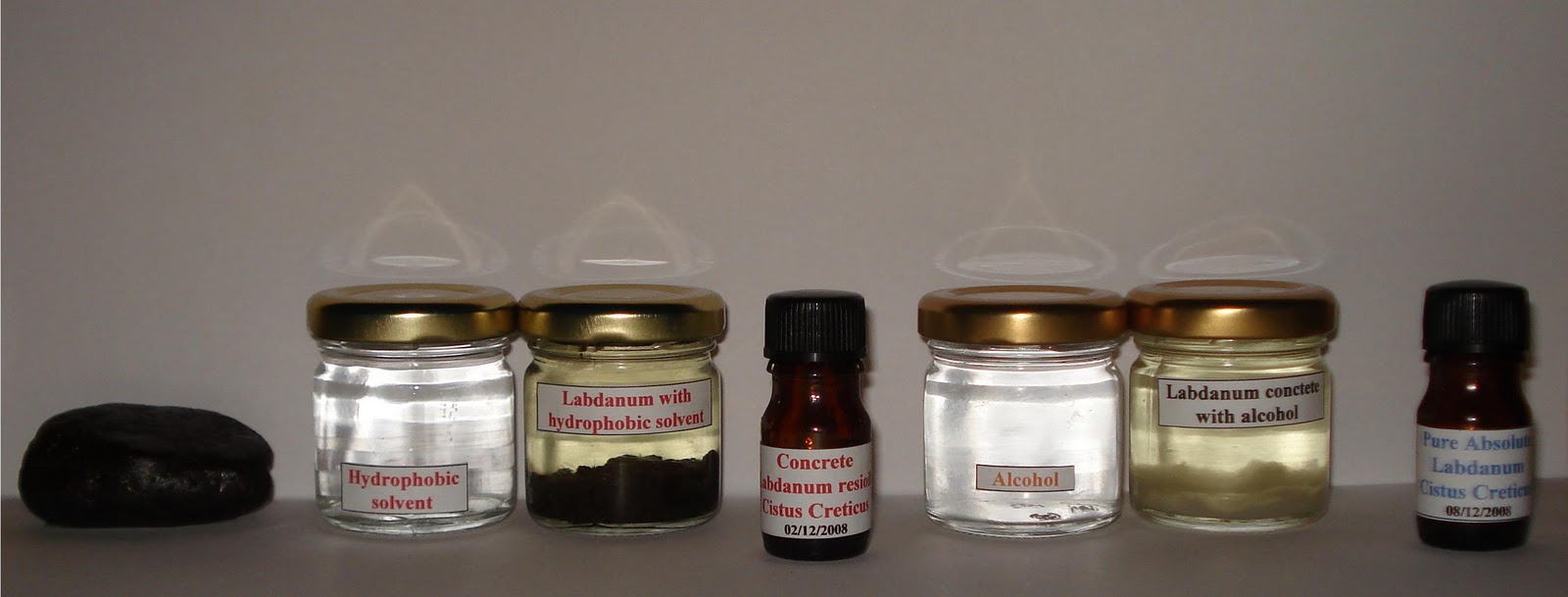
The first step:
Α solvent such as hexane or supercritical carbon dioxide is used to extract the oils. Extracts from hexane and other hydrophobic solvent are called concretes, which is a mixture of essential oil, waxes, resins, and other lipophilic (oil soluble) plant material.
The second step:
Prep for all highly fragrant, concretes contain large quantities of non-fragrant waxes and resins. As such another solvent, often ethyl alcohol, which only dissolves the fragrant low-molecular weight compounds, is used to extract the fragrant oil from the concrete. The alcohol is removed by a second distillation, leaving behind the absolute.
b.Modern method : CO2 Extraction
CO2 extracted oils are high quality oils extracted using carbon dioxide in liquid form, as the solvent. When carbon dioxide is converted to liquid by using low temperatures and high pressure, it becomes a very safe and effective solvent that allows all the desireable active constituents of a plant to be collected without the risk of heat degradation. Once the extraction is complete, the carbon dioxide is allowed to go back to its natural gaseous state, leaving behind only the extracted essence of the plant. CO2 extracted oils are the closest representation of the natural plant ever achieved.
Two types of oils are obtained using this method of extraction:
CO2 Selects:
Selects are oils which are extracted at lower pressures and contain only the volatile, CO2 soluble components. The heavier waxes, resins, and color compounds are left behind. The viscosity of a select oil is generally thick but pourable. These oils closely resemble steam distilled oils in composition, however, they may contain more volatile components that are not extracted during steam distillation.
CO2 Totals:
Totals are oil that are extracted at higher pressures and contain both the volatile and non-volatile CO2 soluble components of a plant. These oils contain the essential oil of the plant plus the heavier waxes, resins, color compounds, making them very similar to the plant itself. CO2 totals are generally thick and pasty but are soluble in essential oils and vegetable oils (although some may need gentle warming).
Products
DESCRIPTION : Labdanum is also known as the Rose of Sharon and is mentioned in the Bible in several locations. An essential oil of this plant is also produced. It is typically called Cistus essential oil. The most important for use in natural perfumery is Labdanum Absolute. Labdanum Absolute is refined from Labdanum Gum in a 2 step process. First a concrete is made using a solvent such as hexane or heptane. Next the Labdanam Absolute is extracted from the concrete. Labdanum Absolutes can vary dramatically depending on how they are extracted and by which solvents are used during the refinement process. The best Labdanum Absolutes are lighter in color, more pourable, more soluble in fixed oils, and blend with other essential oils
Labdanum concrete.
 |
| Labdanum concrete. |
Labdanum Absolute
 |
| Labdanum Absolute. |
In the same results we
reach if we cut branchs.
C) Solutions
 |
| 1. With pure alcohol. 2.with olive oil. |
a.With pure alcohol.
The laudanum is dissolved completely in alcohol.
b.with olive oil.
The laudanum is dissolved completely in olive oil.
c.Water.
Labdanum is dissolved more in water when we boil it.
9.2.11
FARM OF LABDANUM
 |
| Flega "mitato" at Galinus Sises Creta. |
 |
| Flega - spring |
 |
| Beach of Gallinus. |

 |
| Goats with labdanum. Unique point in the World even today. |
 |
| Goats with labdanum. Unique point in the World even today. |
 |
| Goats with labdanum. Unique point in the World even today |
 | ||
| Stone House in Gallinus. "Mitato". |
8.12.10
History labdanum Menu
With the historical reports likely existed three regions where they were collected the laudanum.
i). Ancient Mesopotamia.
ii)Ancient Egyptian
B). Gilead
i.Myrrh in the Old Testament.
ii.Myrrh of Bible.
iii Myrrh in Bible part2
iv.One of the three gifts the Magi.
v. Lot
2.Balm of Gilead .
i.Balm of Gilead
ii.BALM
3.Onycha.
i.ONYCHA - LABDANUM
ii.What is Onycha?
4.Rose of Sharon->Cistus Creticus.
i.Precious Oils ~ A Study of the Fragrances of the Bible~Flowers~Rose of Sharon חבצלת chabatstseleth
i.Modern Medical Uses of Some Plants of the Qu'ran and the Bible
C) Cyprus Chypre - Chypre Perfume.
The abbey region where is collected the laudanum in our days is ONLY in northern Crete.
D)Northern Crete (the only point in that is possible the collection labdanum today).
Ancient Crete (Minoan civilization)
Two Aromatic Herbs of Ancient Crete
Report of Crete.
Cistus with pink flower ONLY!
A)Northern Africa.
i). Ancient Mesopotamia.
ii)Ancient Egyptian
- Laudanum: the beginning of one from bigger culture of Ancient World. "Ancient Egyptian"
- Ancient Egypt
- Crook and flail
- Farm of labdanum
- Crook today Flail today
- University of Chicago
- Cleopatra
B). Gilead
i.Myrrh in the Old Testament.
ii.Myrrh of Bible.
iii Myrrh in Bible part2
iv.One of the three gifts the Magi.
v. Lot
2.Balm of Gilead .
i.Balm of Gilead
ii.BALM
3.Onycha.
i.ONYCHA - LABDANUM
ii.What is Onycha?
4.Rose of Sharon->Cistus Creticus.
i.Precious Oils ~ A Study of the Fragrances of the Bible~Flowers~Rose of Sharon חבצלת chabatstseleth
i.Modern Medical Uses of Some Plants of the Qu'ran and the Bible
C) Cyprus Chypre - Chypre Perfume.
The abbey region where is collected the laudanum in our days is ONLY in northern Crete.
D)Northern Crete (the only point in that is possible the collection labdanum today).
Ancient Crete (Minoan civilization)
Two Aromatic Herbs of Ancient Crete
Report of Crete.
16.6.10
Use Cistus Incanus Menu.
B)CISTUS INCANUS.
Working with Cistus
Essential oil of Cistus Creticus
Use:
Aromatherapy
- Tea
- Cretan Tea
- Herbal Tea.
Working with Cistus
Essential oil of Cistus Creticus
Use:
Aromatherapy
29.4.10
Cistus Incanus Menu.
Compact shrub, approximately 1 m (3 1/3 ft) tall and equally wide, with gray-green foliage and 5 – 6.5 cm (2 – 2 1/2 in) pink "roses" that appear in late winter – early spring. Both the leaves and flowers have a wrinkled appearance.
According to "Plants for a Future", ssp. Cistus Incanus Creticus and, I suspect, all Rock Roses, have several uses. In particular, leaves can be used as a tea substitute, whilst the oleo-resin obtained from the leaves and stems is used as a commercial food flavoring in baked goods, ice cream, chewing gum etc.
In addition, the plant is an aromatic, expectorant, stimulant herb that controls bleeding and has antibiotic effects. It is used internally in the treatment of catarrh and diarrhoea and as an emmenagogue. The leaves are harvested in late spring and early summer and can be dried for later use, or the resin extracted from them.
Finally, the glandular hairs on the leaves yield the oleo-resin "ladanum", which, some sources, associate with the "myrrh" of biblical references, It is used medicinally and in soaps, perfumery, fumigation etc. This resin is an acceptable substitute for ambergris (which is obtained from the sperm whale) and so is important in perfume manufacture. The resin is collected by dragging a type of rake through the plant, the resin adhering to the teeth of the rake, or by boiling the twigs and skimming off the resin. Most resin is produced at the hottest time of the year.
 |
| Cistus Incanus. |
 |
| Collection of labdanum today in Northen Crete. |
Subscribe to:
Posts (Atom)